
Why Your $1,000 Penetration Test Isn't a Penetration Test
Part of NaviSec's Penetration Testing Buyer's Guide.
If you've shopped for penetration testing services and gotten a quote for $1,000 — or seen a subscription tool advertise "continuous pentesting" for a couple hundred dollars a month — you weren't looking at a penetration test. You were looking at a vulnerability scan wearing a penetration test's name tag.
That's not a knock on vulnerability scanning. It's a legitimately useful, legitimately cheap tool. The problem is what happens when a cheap penetration test is sold as the real thing, and an organization ends up with a compliance checkbox and a false sense of security instead of an actual understanding of how an attacker would get in.
What a Real Penetration Test Actually Involves
A real penetration test is performed by a human — usually a small team of them — following a defined methodology like PTES (the Penetration Testing Execution Standard). That means:
- Manual exploitation, not just detection. A scanner flags that a service might be vulnerable. A tester exploits it to confirm it is, and shows you what an attacker could actually reach from there.
- Chaining findings together. Real attackers rarely need one critical vulnerability — they chain three or four medium findings into a path to domain admin. Automated tools report findings in isolation; humans connect them the way an adversary would.
- Business logic testing. A scanner can't tell that your "apply discount code" endpoint lets a user apply the same code infinitely, or that a password-reset flow leaks whether an email address exists in your system. That requires someone who understands your application, not just its HTTP responses.
- Judgment about what actually matters. Every environment produces false positives and low-priority noise. A skilled tester filters that down to what's actually exploitable and actually worth fixing first.
- Time. Real engagements run days to weeks, not minutes. That time is the entire point — it's where the manual work happens.
What You're Actually Buying for $1,000
At that price point, one of two things is happening:
- You're buying an automated vulnerability scan, possibly run through a nicer-looking report template with the word "penetration test" on the cover. Vulnerability scans are inherently cheap because a machine is doing all the work — no manual exploitation, no chaining, no business-logic review.
- You're buying an AI-generated report with minimal-to-no human validation behind it. This is the newer version of the same problem, and it deserves its own section.
The AI Pentesting Hype — And Why It's Not There Yet
AI-driven "autonomous pentesting" tools have gotten a lot of marketing attention, and it's worth being direct about where they actually stand. As of 2026, the industry's own confidence in them is falling, not rising: the share of organizations willing to rely on AI-powered penetration testing dropped to 9%, down from 29% the year before.
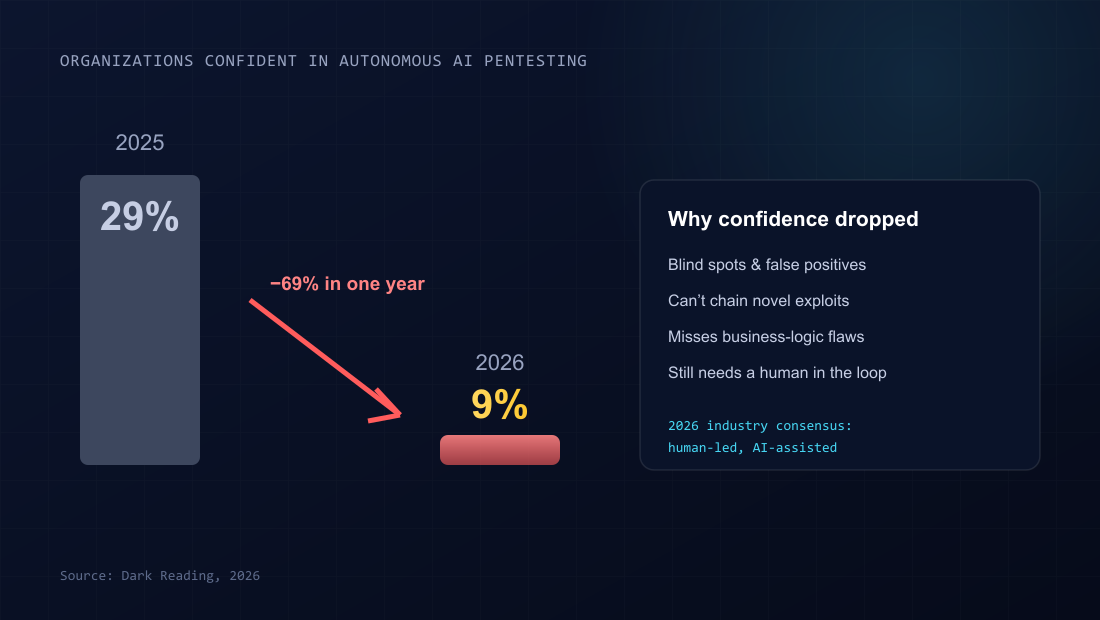
The reasons line up with what practitioners have been saying for a while:
- Blind spots and false positives. AI-based scanning still produces significant noise and misses that require human review to sort out.
- No real creativity. AI tools can execute known attack patterns quickly, but they still lack the adaptability to chain novel exploits together or reason about business-logic flaws the way an experienced human does.
- Stale knowledge. Models trained on historical data can miss emerging techniques unless constantly retrained — attackers don't wait for the next training cycle.
- Still needs a human in the loop. Even the more advanced AI-assisted approaches require a person acting as supervisor and decision-maker — "hands-off-the-keyboard" autonomous testing isn't there yet.
None of this means AI is useless in security testing — it's a genuinely good force multiplier for repetitive reconnaissance and triage. But a force multiplier isn't a replacement. The consensus among practitioners in 2026 is a hybrid model: AI handles the repetitive grunt work, humans handle the exploitation, chaining, and judgment calls that actually determine whether a finding matters. A report generated only by AI, with no experienced human validating and exploiting the findings, isn't a penetration test — it's the same automated-scan problem with better prose.
Why There's No Honest Flat Rate for Penetration Testing
Because the work is manual and time-intensive, real penetration testing costs scale with how much there actually is to test — not with a provider's marketing budget. A five-person company running one straightforward web app can have a bigger attack surface to manually work through than a much larger company with a tightly scoped internal network, especially once authenticated web application testing, APIs, or social engineering are in scope. There's no honest flat rate that fits both, which is exactly why a legitimate provider scopes before quoting instead of the other way around.
That's the real tell: if someone quotes you a fixed, rock-bottom price before asking a single question about your environment — number of hosts, applications, whether social engineering is in scope — walk away. A real quote comes after a scoping conversation, not before one.
Red Flags When You're Shopping for a Pentest
- The price is a flat rate with no scoping questions asked
- No named testers, no certifications mentioned (OSCP, CREST, GCIH, etc.)
- No methodology referenced — nobody can tell you if they follow PTES, OSSTMM, or anything else
- No sample report available on request
- Turnaround measured in hours or a couple of days, not weeks
- Retesting the fixed issues costs extra
- The word "AI-powered" is doing all the marketing work with no mention of human validation
How NaviSec Does It
Every NaviSec penetration test is performed by experienced human testers, following PTES methodology, with findings you can actually act on — not a scanner printout. We publish a sample penetration test report so you can see the format before you commit, and retesting of remediated findings is free within 90 days of report delivery. If you want to know what real scoping looks like, start with a conversation — we'll give you a clear, fixed quote based on your actual environment, not a number pulled out of thin air.
Frequently Asked Questions
Is a vulnerability scan worthless, then?
No — it's a genuinely useful, cheap way to catch known, unpatched issues on a regular cadence (monthly or quarterly is common). The problem is only when it's sold as a penetration test. Most mature security programs use both: frequent automated scanning plus periodic human-led penetration testing. See our full breakdown of penetration testing vs. vulnerability assessment for the complete comparison.
How do I verify a quote is for a real penetration test?
Ask three questions: Who's doing the testing, and what are their certifications? What methodology do they follow? Can I see a sample report? A legitimate provider answers all three without hesitation.
Does NaviSec use AI at all?
Where it genuinely helps — speeding up reconnaissance and repetitive triage — yes. Every finding that ends up in your report is manually validated and exploited by a human tester before it's reported to you.
Why does retesting matter?
Remediation doesn't always work the way a dev team thinks it did. Free retesting within 90 days means you're not paying twice to confirm a fix actually closed the hole — and it's a good sign a provider stands behind their findings.